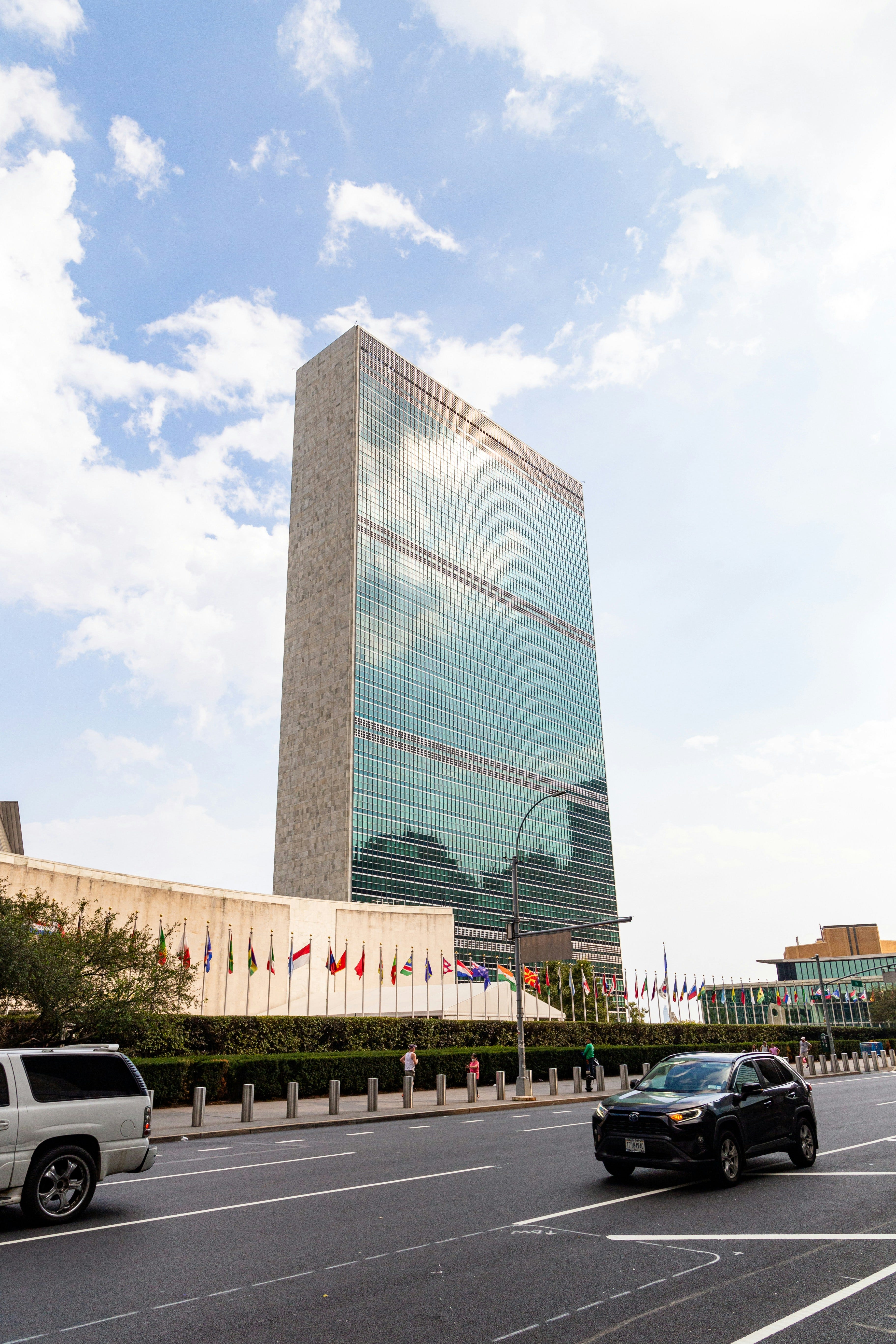
Photo by Maxim Klimashin on Unsplash
My good colleague Danny Bradlow from ‘Tukes’, the University of Pretoria in South Africa put it starkly this week in The Conversation – but I suspect pretty much ‘dead on’:
“The international legal order that was created after the second world war is no longer fit for purpose.”
“Its key institutions like the United Nations are incapable of restoring peace in Ukraine, Iran, Sudan or the Democratic Republic of Congo or stopping genocides in places like Myanmar or Palestine.”
“These developments lead many people to conclude that international law is merely nice-sounding words that hide a more cynical truth: the only effective international legal rule is (and has always been) that “the strong do what they can and the weak suffer what they must”, as the ancient Greek historian Thucydides put it.”
Now, interestingly, Zaki Laidi has tried to put this current disorder into some understandable frame. Zaki published not long ago a very good book with my close colleague, Yves Tiberghien, The Hedgers: How The Global South Navigates the Sino-American Competition. Now, in a recent article in Project Syndicate, titled, “The Myth of Global Chaos”, he tackles the current state of the global order:
“Today’s seemingly nonstop international tumult is not as unintelligible as it seems. What pundits lazily describe as chaos is the culmination of developments that were long in the making and arrived at a time when the international system was no longer able to prevent or mitigate geopolitical shocks.”
“The shambolic diplomacy between US President Donald Trump’s administration and Iran provides further evidence that world affairs have become unintelligible. But take a step back and you will see that all of today’s major conflicts are of a piece, and that despite the apparent entropy, a powerful logic of adaptation and resilience is at work.”
And then Zaki examines the outstanding serious conflicts.
“The four biggest flash points today stem from historical processes that made them largely predictable. The ferocity of Russia’s invasion of Ukraine may have shocked the world, but the war itself followed from the Kremlin’s well-known resentments and insecurities. President Vladimir Putin had long made clear that he abhorred the idea of Ukrainian independence or strategic alignment with the West. As former US National Security Adviser Zbigniew Brzezinski warned in the
1990s, “Without Ukraine, Russia ceases to be an empire.””“There is no need for chaos theory or psychoanalysis. The war is simply the result of a Russian determination not to accept its status as a post-imperial power.”
He takes the same lens turning to the current conflicts in the Middle East:
“The same applies to the Middle East, where both the Israeli-Palestinian conflict and the US/Israeli-Iranian war have had grave consequences. What is most striking, yet again, is not their irrationality, but their persistence. It has long been obvious that only a compromise, trading some territory for the prospect of lasting peace can settle the dispute over the Holy Land. Yet we have moved further than ever from that outcome. The conflict has grown only more violent and terrible; but that does not make it irrational or unintelligible.”
And so too also the Iran conflict:
“Like our previous examples, the war with Iran has roots in events that happened decades ago, namely the 1979 revolution. The Islamic Republic was established in open opposition to the West, which bears its own share of responsibility for how things have evolved. The basic contours of the conflict have not changed: Iran wants to assert its hegemony in the region at the expense of Israel, the US, and the Gulf states, which in turn want to clip its wings.”
His conclusion:
“All of these cases show that what pundits lazily describe as chaos is the culmination of developments that were long in the making and arrived at a time when the international system was no longer able to prevent or mitigate geopolitical shocks. We no longer have the institutional stabilizers that we once did, and Trump bears much of the blame for that.”
“Faced with so many high-stakes conflicts and disruptions, it is not surprising that many are declaring the international system dead. But the reality is more nuanced. Despite the uncertainty incited by Trump’s import tariffs, for example, world trade continues to grow, and supply and value chains
are simply reconfiguring, not collapsing.”
Yes, the global order, frayed as it is, remains. But it is frayed, very frayed. And we need action to reestablish order. But where and how? Certainly not the current multilateral institutions. This diminishment of the multilateral institutions designed to carry out peace and security is all too apparent. One gets a sense of this fading by following the current election for the Secretary General of the UN. It is described in part by Stephanie Fillion, editor-in-chief of Envoy, a magazine focused on the United Nations, diplomacy and global affairs. In a piece in The Interpreter from Australia’s Lowy Institute she writes:
“With the Security Council expected in July to begin closed-door deliberations, including informal straw polls, the contest in New York City so far appears to be defined by a longtime leading candidate in International Atomic Energy Agency chief Rafael Grossi and the expectation of surprise, last-minute contenders.”
“Guterres’ successor must manage an institution battered by the reality of several bitter wars, mistrusted by major powers and under pressure to shrink. The question is not only who wants the job, but who can still make the job matter.”
But before taking on the task, the divided permanent five powers of the Security Council – China, France, Russia, the United Kingdom and the United States – must agree which candidate embodies their drastically different views of the future of the institution. While many people believe it will be harder than ever, others think that the P5 will unite around preserving that very privilege. The process itself exposes the contradiction of the UN: it needs a bold leader, but the P5 may prefer a controllable one.”
“When the UN General Assembly held its interactive dialogues with candidates in April, several diplomats shared their disappointment by how few people were running for the job. At the time, four candidates presented their vision to the world body: Argentina’s Grossi, Costa Rica’s Rebeca Grynspan, Chile’s Michelle Bachelet, and Senegal’s Macky Sall. In 2016, 13 candidates ran
for the job.””“Experts saw people’s reluctance to run as a reflection of how difficult the job has become.”
Difficult, well probably closer to impossible where the institution has been vetoed out of almost every current conflict by one or other member of the P5. So, the leading and major powers have done a very good job in hobbling the international order and its multilateral initiatives, undermining efforts to resolve conflicts.
It strikes me that this critical arena of ‘peace and security’ is an arena for Middle Power collective action. It is, of course, a ‘tall order’. No kidding. But nothing is more critical. There is a real need to be ‘bold’ leaders determined to be institutional stabilizers. And a ‘coalition of the willing’ of Middle Powers can start by calling out these depressing actions by the great powers.