
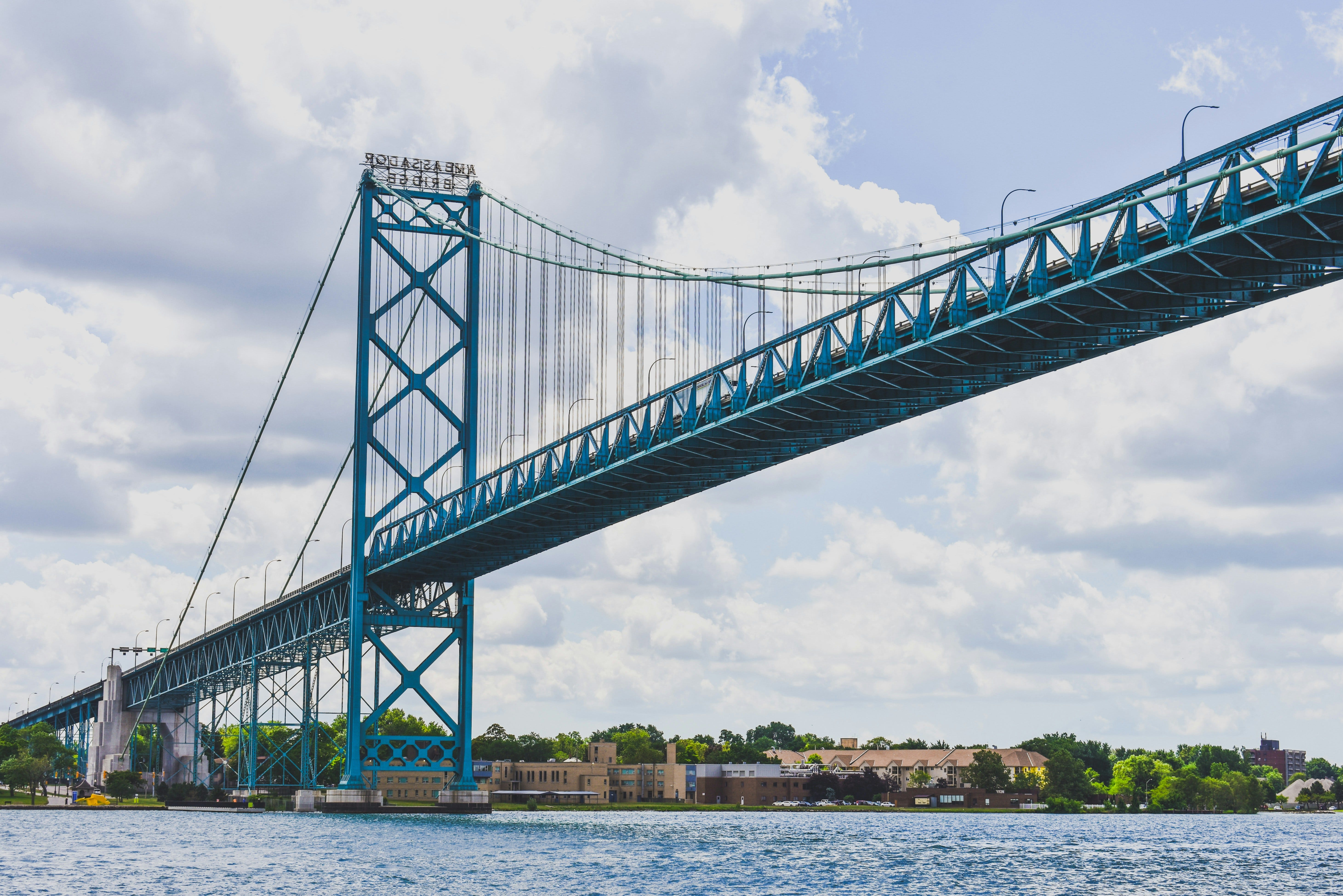
Photo of Ambassador Bridge by N Band on Unsplash
So we are approaching a declaration by the 3 North American governments – Canada, Mexico and the United States on the fate of US-Mexico-Canada Free Trade Agreement. Not totally surprisingly, President Trump has expressed his ‘distaste’ for the renewal. As described in the Toronto Star by Tonda MacCharles:
“Prime Minister Mark Carney publicly said little, but privately projected calm after U.S. President Donald Trump declared he is “not looking to renew” the Canada-U.S.-Mexico Agreement on free trade as the July 1 deadline looms for the three nations to recommit to the deal.”…
“Trump’s latest offhanded diss of the cross-border trade deal came when a reporter in the Oval Office asked the president how confident he is the free trade pact would be renewed by July 1, and what more Canada could do.
“Well, I’m not looking to renew it,” the president flatly replied.”
““I don’t know that I’m going to renew it, because to be honest with you, the United States does much better,” Trump said, adding: “We don’t need anything that Canada has, we don’t need anything that Mexico has, but they need everything that we have.”
“Trump then said the current CUSMA is “a great deal for one reason: it gave the right to terminate,” suggesting he could one day threaten a complete withdrawal from the deal. “I made it, but I had the right to terminate, and you know, with NAFTA, we didn’t have the right to terminate.””
Imagine, the best thing that President Trump has to say about the trade agreement – which of course he negotiated – is that he can terminate it.
As Michael Froman, the President of the Council on Foreign Relations (CFR) wrote recently:
“Last September, Carney and Mexican President Claudia Sheinbaum announced their own bilateral Comprehensive Strategic Partnership, an attempt to hedge against an unreliable Washington and present a united front in advance of the mandatory joint review. The stage is now set for a fraught renegotiation.”
As US Ambassador to Canada, Pete Hoekstra reminded Canadians there are several outcomes possible from the possible renewal as described by him and reported in The Globe & Mail:
“The three countries have the option to renew the deal for 16 years. If that doesn’t happen, the treaty will remain in place but move into a period of annual reviews for 10 years. Any of the countries can also withdraw from the deal with six months notice.”
The Ambassador’s view for Canada and Canadians for advancing this USMCA negotiation:
“You maybe don’t like the way the President says it, but … what he’s saying is we’re open to offers. Make your case,” Mr. Hoekstra said.
“Mr. Hoekstra said the Trump administration knows it needs things from international partners, even as it looks to reshore key industries and build up U.S. manufacturing. Canada, he said, can be the preferred partner across a range of industries if it can make the argument to Washington.”
““I think Canada should optimistically look at this, and with all of the resources that you have, and the capabilities that you have, and the talent that you have, go into these negotiations very aggressively and say, ‘We know America has needs across the board, and we’re here to partner with America and fill those needs because we are the best place for America to fill these needs,’” Mr. Hoekstra said.”
It seems apparent that Trump and his administration have concerns over resolving trade problems with Canada. Again as Michael Froman describes it:
“Second, the USMCA negotiations reveal how serious the fissures are between the United States and Canada. When the USMCA was concluded more than six years ago, negotiations with Mexico were the more challenging ones. Now, Canada is the pain point.”
“Then, Deputy U.S. Trade Representative Rick Switzer said at a CFR event, “We have issues with Mexico we’re still working through, but Mexico intends on coming to an agreement with us.” He added, “The grown-ups are in the room talking because there’s a grown-up in leadership there. And I would argue there’s not a grown-up in Canada in charge.”
Ouch. That hurts for sure.
“There are still a number of authorities—including Sections 301, 232, 201, and 338—Congress has provided the president to impose tariffs in response to significant trade issues or bona fide national security ones. But USMCA is consequential for Canada and Mexico and, therefore, the review is a unique source of negotiating leverage.”
That being said, and notwithstanding all the low level invective being expressed by US officials, I suspect the framing of this negotiation – expressed by a former Canadian trade official – probably remains the most likely view of the state of the negotiation between the Carney government and the Trump administration, as quoted by MacCharles at the Toronto Star:
“Brian Clow, a senior Canada-U.S. adviser to former prime minister Justin Trudeau throughout Trump’s first term, said, “It’s completely predictable and expected to hear this from the president.” Trump, Clow said, regards himself as “a master negotiator (and) is going to keep the pressure on.””
“Clow, who is now a private-sector trade consultant, suggested the risk that the U.S. would pull out of the trade deal altogether is “very low.” He said “the Canadians should stay calm, just keep their head down and just keep talking.””
And, finally, a view from Lana Payne, the national president of Unifor that underscores the logic of Trump’s harsh perspective:
“Lana Payne, national president of Canada’s largest private-sector union, said in a statement to the Star she predicted last year “Canadians could expect more threats, posturing, and economic extortion from Donald Trump as the CUSMA review moves forward.”
““Trump’s objective is clear: attempt to squeeze more concessions out of Canada while taking aim at our industrial economy and the workers that drive our economy.””
And so, notwithstanding the negativity expressed by the President and some of his officials, the logic is for Canadian officials and negotiators to push on with some confidence that in the end a deal can be secured.
Finally, and underscoring the serious difficulties of negotiating with this President, and with even greater stakes at play, there is the current effort to end the conflict in the Middle East. As described in an ongoing saga of swinging rather wildly from military action to landing on the doorstep of conflict resolution here a description of Trump veering between negotiation and violent action, as described in the NYTimes by Max Bearak, Eric Schmitt, Anupreeta Das and Jonathan Swan, in “Iran War Live Updates”.
“After two days of pounding Iran with airstrikes, President Trump on Thursday morning promised to hit Iran hard again for a third day and mused about invading a strategic island. Then in the afternoon he abruptly called off the attacks, and claimed, once again, that a deal was close to being signed.
Iran’s leadership did not immediately confirm any progress in the talks. Earlier this week, Mr. Trump had claimed a peace deal was imminent, but hours later, the two countries attacked each other.”
Today, according to The Economist, the end is both here, and it is not:
“Mr. Trump is in a triple bind. Iran is garrotting the global energy supply by threatening tankers in the Strait of Hormuz. Israel is bombing Lebanon, despite Mr. Trump telling it not to. And hawks in America are pressing Mr. Trump to chase unrealistic war aims. Something must eventually give. But the mess that Mr. Trump created by starting the war could take longer to clear up than markets are expecting. The world must prepare for higher energy prices.” …
“The best Mr. Trump can hope for is a makeshift pact to reopen the strait in exchange for an extended ceasefire that may, with luck, become permanent. Economic sweeteners will be necessary. The threat of force will remain. Haggling over Iran’s nuclear programme will have to come later. Such a deal would be unstable, and humiliating for America.”
Trump seems to be able to break things, for sure, but improving relations, enhancing stability and the global order, not so much.