
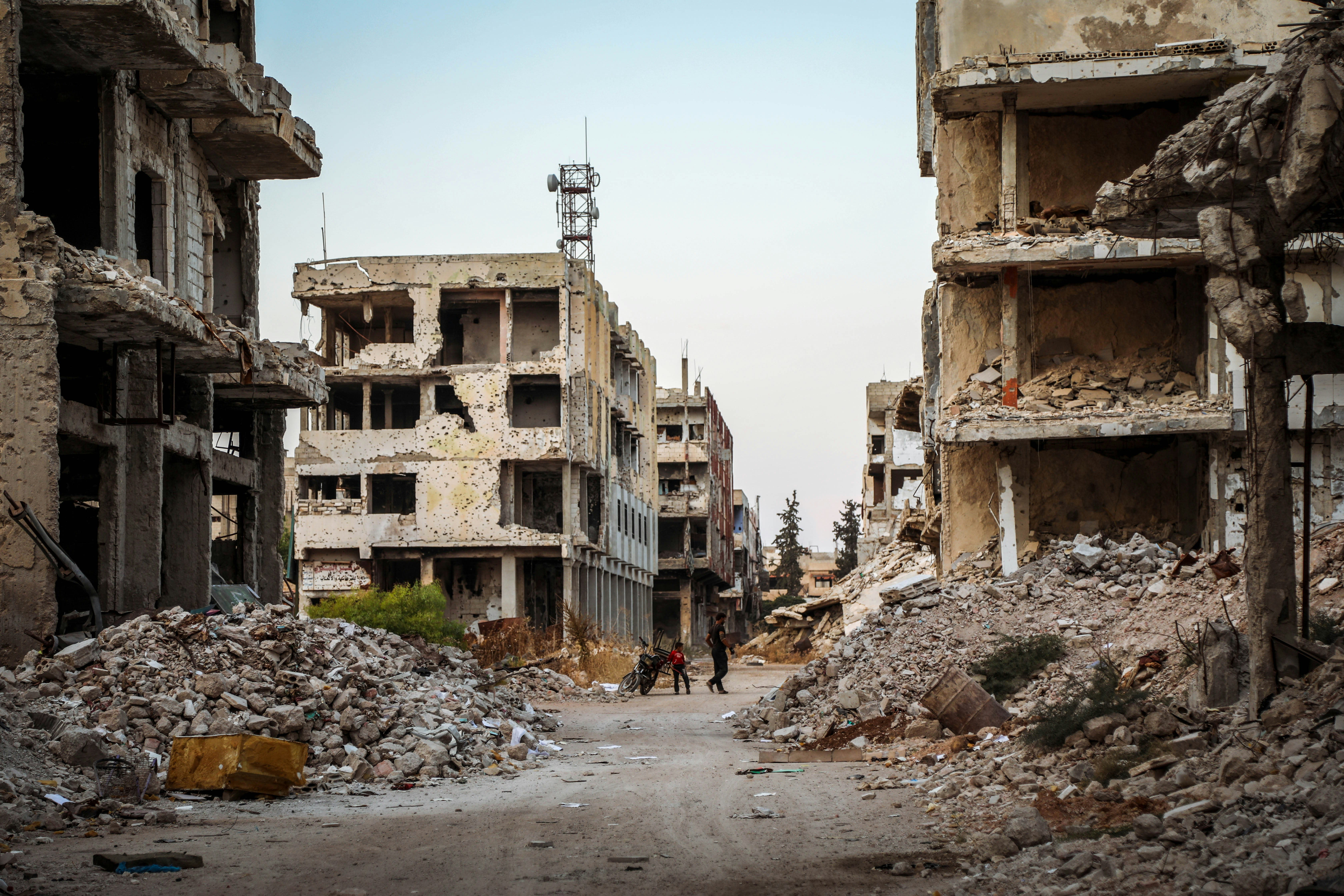
Photo by Mahmoud Sulaiman on Unsplash
It is hard to turn away, and not to wonder almost immediately the near and longer term consequences of this latest conflict. I am of course thinking of war in the Middle East and the immediate ceasefire between the US and Iran though evidently not with Israel with respect to Hezbollah in Lebanon, or so says Israel and the US administration.
So, thinking about the war’s near term consequences may have been best said, perhaps, by Michael Froman, the President of the Council on Foreign Relations (CFR) in the “World This Week”:
“People are now asking whether the war was worth it. The truth is that it’s simply too soon to tell. The success or failure of the war to advance the United States’ national interest hinges as much on what happens next as it does on what happened over the course of the past forty-one days.”
And one is unable to avoid thinking of the impact of the war on the global order as well. I will turn to the war and its immediate impact in just a moment. But I wanted to look beyond this evident disorder in the system and raise again the concern for the state of multilateralism and what many have called the ‘crisis of multilateralism’. This concern has been heightened following the recent WTO meeting. Now the reform of the WTO has been on our ‘multilateral score card’ for quite some time. But the failure of reform has been more than evident for some time and more immediately on the just concluded Ministerial gathering.
‘The Crisis of Multilateralism’
The failure of multilateral reform and repair has been well described by William Reinsch at CSIS this past week:
“What began two years ago after the 13th ministerial conference with high ambitions—reform the institution, finish the fisheries agreement, add pending joint statement initiatives to the body of WTO rules, make tangible progress on agriculture, extend the e-commerce tax moratorium—ended without accomplishing any of those things.”
A necessary longer list of reforms for the recent Ministerial had been dramatically pared back to just two:
“… there were essentially only two on the table—a work plan for reform, itself a significant step back from considering actual reforms, and an extension of the e-commerce moratorium.”
But even that, imagine, even that proved too much for the WTO:
“By the end of the conference, neither goal had been achieved, and the conference ended without the usual ministerial declaration and punted the agenda to future meetings of the WTO General Council, which is composed of the same people who spent the last two years failing to agree on the same issues. If ministers could not agree, handing the ball back to the second team is not likely to be a key to success.”
“The proximate cause was last-minute disagreement over the length of the e-commerce moratorium. The United States strongly advocated for a permanent extension, both on the merits and its desire to avoid having to go through the torture of trying to get it renewed every two years, but more favored another time-limited extension, but for longer than two years. A compromise of a five-year extension with a required review after four years appeared to be in reach when Brazil, joined by Türkiye, announced they would not support anything longer than another two-year extension.”
Years worth of failure follow from WTO Ministerials and beyond them of course of the overwhelming disuse of the WTO dispute resolution mechanism. Yes, there has been an alternate voluntary mechanism created, the Multi-Party Interim Appeal Arbitration Arrangement (MPIA). Currently there are 61 members but still critical members, such as the United States, are not. But I don’t want to be too negative. It appears that ‘coalitions of the willing’ may yet drive reform here and potentially in other wounded multilateral institutions. And as pointed out by Reinsch, such plurilateral action may be afoot here at the WTO, as well:
“The countries already participating cover 70 percent of world trade, so this is not an insignificant event. Thanks primarily to expected Indian opposition, the agreement will not yet be part of the WTO rulebook, but it was done under the WTO umbrella and signals an approach we will be seeing more often—coalitions of the willing moving ahead on trade liberalization, leaving behind those who decline to participate.”
We need to see more ‘coalitions of the willing’ – ‘loud’ and vocal groups heralding collective agreement on reforms and on new initiatives. The days of unanimity in a geopolitically riven world have for the moment receded. It may be unfortunate but multilateral action, reform and advancement is needed – and now. And the way forward is, I suspect, clear.
Back to the Middle East and Conflict
All right back to conflict in the Middle East and possible ways forward from this evident disorder.
Susan Glasser at The New Yorker, put her finger on the current arrangement in a piece titled, “The Costs of Trump’s Iran-War Folly”:
“If this was victory, I’d hate to see what failure looks like. Perhaps the most immediate problem with the ceasefire—which was, according to Trump, supposed to be conditioned on the “COMPLETE, IMMEDIATE, and SAFE OPENING of the Strait of Hormuz”—is that it has not actually resulted in the complete, immediate, and safe opening of the Strait of Hormuz, according to those who have been monitoring it.”
“Iran has not only retained control over the strait through which one-fifth of the world’s oil-and-gas supply flows; it now asserts the right to charge millions of dollars in tolls to ships that wish to pass—a new status quo sanctioned by Trump that will enrich and entrench the theocratic government he started out the war wanting to topple. As long as this continues, oil prices will remain high and the world economy will pay the price for America’s costly war.”
She then goes on to describe the consequences of the action and its halt by the ceasefire:
“Instead of regime change, Trump has succeeded merely in swapping one Supreme Leader named Khamenei—the aging ayatollah whose killing Trump celebrated on the first day of the war—for another Supreme Leader named Khamenei, the ayatollah’s son, who appears to be even more of a hard-liner than his father was.”
“As for the many, many other goals for the conflict that Trump had offered at various points, suffice it to say that he failed to achieve anything like the obliteration of Iran’s nuclear program, ballistic-missile arsenal, or proxy network of terrorist allies that might have constituted a positive outcome. (The reason, no doubt, that Israel kept firing away at Hezbollah in Lebanon even after the ceasefire was announced.) “Unconditional surrender” this was not.”
She draws the possible follow on consequences:
“The longer-term and less tangible costs may be even higher, as measured in the strained alliances in Asia and Europe with allies who refused to join Trump’s war and the erosion of the very idea of America as a global leader.”
“The shocker here was more that Trump—he of the “no new wars” campaign pledge—chose to go for it. This was no doubt because he was operating under his own version of the autocrat’s delusion: that he would achieve fast and nearly cost-free victory over a weakened enemy.”
And the delusion was augmented by the insights into the decision by the Trump administration reaching a decision to act. There was no strategic input into the decision to act though assessment was there. It was all Trump and his gut instinct. As described by Jonathan Swan and Maggie Haberman in the NYTimes, here was the strategic assessment:
“The intelligence officials had deep expertise in U.S. military capabilities, and they knew the Iranian system and its players inside out. They had broken down Mr. Netanyahu’s presentation into four parts. First was decapitation — killing the ayatollah. Second was crippling Iran’s capacity to project power and threaten its neighbors. Third was a popular uprising inside Iran. And fourth was regime change, with a secular leader installed to govern the country.”
“The U.S. officials assessed that the first two objectives were achievable with American intelligence and military power. They assessed that the third and fourth parts of Mr. Netanyahu’s pitch, which included the possibility of the Kurds mounting a ground invasion of Iran, were detached from reality.””
And what followed was Trump’s assessment:
“Mr. Trump quickly weighed the assessment. Regime change, he said, would be “their problem.” It was unclear whether he was referring to the Israelis or the Iranian people. But the bottom line was that his decision on whether to go to war against Iran would not hinge on whether Parts 3 and 4 of Mr. Netanyahu’s presentation were achievable.”
“Mr. Trump appeared to remain very interested in accomplishing Parts 1 and 2: killing the ayatollah and Iran’s top leaders and dismantling the Iranian military.”
As for the Strait of Hormuz:
“Mr. Trump appeared to remain very interested in accomplishing Parts 1 and 2: killing the ayatollah and Iran’s top leaders and dismantling the Iranian military.”
“He [General Caine] also flagged the enormous difficulty of securing the Strait of Hormuz and the risks of Iran blocking it. Mr. Trump had dismissed that possibility on the assumption that the regime would capitulate before it came to that. The president appeared to think it would be a very quick war — an impression that had been reinforced by the tepid response to the U.S. bombing of Iran’s nuclear facilities in June.”
“At no point during the deliberations did the chairman directly tell the president that war with Iran was a terrible idea — though some of General Caine’s colleagues believed that was exactly what he thought.”
It came down to the President’s interest in dismantling the regime. As the two describe it:
“Of all the foreign policy challenges Mr. Trump had confronted across two presidencies, Iran stood apart. He regarded it as a uniquely dangerous adversary and was willing to take great risks to hinder the regime’s ability to wage war or to acquire a nuclear weapon. Furthermore, Mr. Netanyahu’s pitch had dovetailed with Mr. Trump’s desire to dismantle the Iranian theocracy, which had seized power in 1979, when Mr. Trump was 32. It had been a thorn in the side of the United States ever since.”
“The president had effectively made up his mind weeks earlier, several of his advisers said. But he had not yet decided exactly when. Now, Mr. Netanyahu urged him to move fast.”
Even though there were doubts apparently in the room they were not clearly expressed. Instead this is what transpired:
“When it was his turn to speak, Mr. Rubio offered more clarity, telling the president: If our goal is regime change or an uprising, we shouldn’t do it. But if the goal is to destroy Iran’s missile program, that’s a goal we can achieve.”
“Everyone deferred to the president’s instincts. They had seen him make bold decisions, take on unfathomable risks and somehow come out on top. No one would impede him now.”
“I [President Tump] think we need to do it,” the president told the room. He said they had to make sure Iran could not have a nuclear weapon, and they had to ensure that Iran could not just shoot missiles at Israel or throughout the region.”
The Economist draws the strands together best, it seems to me:
“Not all wars have a winner. But every war has at least one loser and if—a big if—the ceasefire marks the end of the war in Iran, the biggest loser will be Donald Trump. The conflict has set back his chief war aims and revealed the shallowness of his vision for a new way of wielding American power. …”
“The most likely outcome is therefore a wounded Iranian regime clinging to power and holding out for maximal goals in talks. Iran has no navy or air force; it has lost and used up many of its missiles and drones. To make more of them, it will have to contend with the fact that its economy has been set back years by over 21,000 American and Israeli strikes.”
“Mr Trump is calling that a great victory. It doesn’t look like one alongside his scant progress in fulfilling the war’s three most persuasive aims: to make the Middle East safer and more prosperous by taming Iran; to topple the regime; and to stop Iran becoming a nuclear power once and for all.”
So all relying on this President. Doubts were in the ‘room’ but none was clearly articulated and the choices made untethered from strategic assessment and conclusion.