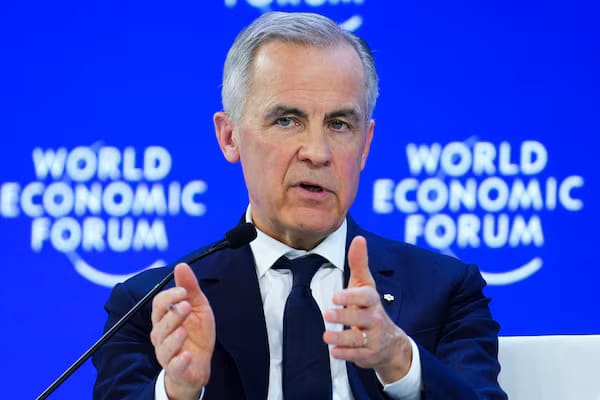
It received a ‘ton’ of attention even in the context of a number of notable speakers, most obviously President Trump. What am I talking about? Well, it was Prime Minister Carney’s speech at Davos. What is interesting is that it drew great attention even in the context of so many other international remarks and most dramatically even in the context of the heightened tensions created by President Trump’s threats and demands. These loud threats of President Trump, and his less than friendly demands were most noticeably directed to NATO ally Denmark and its continued sovereignty over Greenland. As Michael Froman, the President of CFR wrote:
“This year’s Davos theme was “The Spirit of Dialogue,” but in retrospect, it might have been better described as “The Reality of Monologue.” President Donald Trump didn’t just steal the show; he was the show.”
Though Trump ultimately backed away from the worst of his threats to take sovereignty over the vast northern Island – exercising his now well known TACO (Trump always chickens out) muscle, it severely shook US allies in Europe, North America and I suspect elsewhere. Even given all this, great attention was nonetheless paid to Prime Minister Carney’s speech. Again Michael Froman:
“Davos was in many respects a tale of two speeches: President Trump’s and Canadian Prime Minister Mark Carney’s. Both laid bare that we are in the midst of a great disruption and reinforced a growing belief that we must take the world as it is, not as we wish it were. Nostalgia is not a strategy; nor is hope.”
Notwithstanding all the noise from Trump it is clear that the Prime Minister made a notable mark with his speech in Davos. The Prime Minister put it out there notwithstanding Canada is notably vulnerable to the US: It is linked to the United States by an 8,800-kilometre undefended border and Canada is profoundly economically dependent on the US market – over three-quarters of Canadian exports go to the US. But there was in his remarks more than a little expression of speaking ‘truth to power’. As described by Nathan Gardels, the editor of Noema Magazine:
“In the most powerful speech delivered at the World Economic Forum in Davos, Switzerland, this week, Canadian Prime Minister Mark Carney laid out a forward-looking vision for those who must operate in the breach.”
PM Carney made it clear in his Davos speech that the global order has changed under the ‘hammer blows’ delivered by Donald Trump. The PM spoke in the following way about how he sees the global order:
“It seems that every day we’re reminded that we live in an era of great power rivalry — that the rules-based order is fading, that the strong can do “For decades, countries like Canada prospered under what we called the rules-based international order. We join its institutions, we praised its principles, we benefited from its predictability. And because of that, we could pursue values-based foreign policies under its protection.”
“We knew the story of the international rules-based order was partially false, that the strongest would exempt themselves when convenient, that trade rules were enforced asymmetrically, and we knew that international law applied with varied rigor, depending on the identity of the accused or the victim.”
“This fiction was useful, and American hegemony in particular helped provide public goods, open sea lanes, a stable financial system, collective security, and support for frameworks for resolving disputes.”
“Let me be direct. We are in the midst of a rupture, not a transition.”
That delivered line more than almost any other caught the attention of many there and in the press to Carney’s remarks. This ‘rupture’ he just described of the order called for this policy change in global relations according to the Canadian Prime Minister:
“The multilateral institutions on which the middle powers have relied — the WTO, the UN, the COP, the very architecture of collective problem solving — are under threat. As a result, many countries are drawing the same conclusions that they must develop greater strategic autonomy in energy, food, critical minerals, in finance and supply chains. And this impulse is understandable.”
“And there’s another truth: if great powers abandon even the pretense of rules and values for the unhindered pursuit of their power and interests, the gains from transactionalism will become harder to replicate.”
“The question for middle powers like Canada is not whether to adapt to the new reality — we must.”
He then goes on to say:
“And our new approach rests on what Alexander Stubb, the president of Finland, has termed value-based realism.”
“Or, to put it another way, we aim to be both principled and pragmatic. Principled in our commitment to fundamental values, sovereignty, territorial integrity, the prohibition of the use of force except when consistent with the UN Charter and respect for human rights.” …
“We’ve agreed to a comprehensive strategic partnership with the EU, including joining SAFE, the European defence procurement arrangements. We have signed 12 other trade and security deals on four continents in six months.”
“We’re doing something else: to help solve global problems, we’re pursuing variable geometry. In other words, different coalitions for different issues based on common values and interests. So on Ukraine, we’re a core member of the Coalition of the Willing and one of the largest per capita contributors to its defence and security.” …
“Our view is the middle powers must act together because if we’re not at the table, we’re on the menu.”
“In a world of great power rivalry, the countries in-between have a choice: compete with each other for favour, or combine to create a third path with impact. We shouldn’t allow the rise of hard power to blind us to the fact that the power of legitimacy, integrity, and rules will remain strong if we choose to wield it together.”
“It means acting consistently, applying the same standards to allies and rivals. When middle powers criticize economic intimidation from one direction but stay silent when it comes from another, we are keeping the sign in the window.”
“That’s building a strong domestic economy. It should be every government’s immediate priority.”
And he concludes this way:
“We know the old order is not coming back. We shouldn’t mourn it. Nostalgia is not a strategy, but we believe that from the fracture we can build something bigger, better, stronger, more just. This is the task of the middle powers, the countries that have the most to lose from a world of fortresses and the most to gain from genuine cooperation.”
“The powerful have their power. But we have something too: the capacity to stop pretending, to name realities, to build our strength at home, and to act together.”
As just one expression of the seemingly common reaction to the Carney speech are the remarks of Jordan Leichnitz the Canadian Program Manager in Washington for the Friedrich Ebert Stiftung in its IPS publication:
“In Davos, Prime Minister Carney crystallised the choice that lies before Canada, the EU and other middle powers. They can continue, as he put it, ‘the performance of sovereignty while accepting subordination’ or they can pursue new alignments where ‘the power of legitimacy, integrity and rules will remain strong, if we choose to wield them together’. He warned against reliance on old institutions and alliances to protect from new great power threats, and called for a new ‘values-based realism’.”
Somewhat surprisingly was the positive response by Alan Beattie of the FT, not an opinion writer prone to support without much criticism political figures like Carney that he has covered over the years:
“Carney’s analysis is right, and his approach good in principle. But it required the Depression and second world war for countries to overcome their protectionist and isolationist instincts and build a multilateral system. It will take a long time, and probably even more destructiveness from Trump, to prompt the kind of agile system of multi-layered mid-size co-operation that Carney wants to see.”
And Ian Bailly of the Globe and Mail has pointed to an early repositioning by Canada with respect to trade relations:
“Prime Minister Mark Carney has reached a deal with China to allow nearly 50,000 Chinese-made electric vehicles into Canada at a low tariff rate in return for big reductions in Beijing’s levies on canola seed and a promised elimination of its tariffs on a host of other products.”
“At the same time, the deal raises the prospect that Canada may be putting itself offside of Trump’s tough-on-China agenda, which the President expects allies to follow.”
And indeed Alex Ballingall, the Deputy Ottawa Bureau Chief of the Toronto Star pointed to such Canadian statements and actions and the little likelihood that such actions will go unnoticed by the Trump administration:
“But even as he spoke, the world he had described at Davos as entering a new era of intimidation from great powers intruded, with U.S. Commerce Secretary Howard Lutnick suggesting Carney’s new foreign policy moves could further jeopardize North American trade.”
“In an interview with Bloomberg, Lutnick criticized Canada’s relationship-reset with China, called the Carney government “arrogant” and accused it of “complaining.” He also suggested Canada might lose out during the coming negotiations on the Canada-U.S.-Mexico trade accord, over what U.S. President Donald Trump will think of Carney’s overtures to China.”
While most commentators and political figures targeted Carney’s declaration of the demise of the Rules-based Liberal Order, I was more taken by Carney’s appeal to Middle Powers. Now I suppose that is not all that surprising perhaps as we at CWD have had our minds on the role of Middle Powers for some time. But this focus on Middle Powers does not occur without concern over the role and possible success of Middle Powers in the new global order. Yes, there are some Middle Power initiatives, some pointed to by the Prime Minister, but it seems to me we need to see much more in the way of Middle Power Diplomacy before we acknowledge a successful third way. The Trump administration will not go ‘quietly into the night’. For a degree of success we will need to see a wide number of Middle Powers targeting domestic economic growth and far more concerted collective Middle Powers action to advance global governance and rebuild a stable and resilient rules-based order. Serious sustained effort is what we will be looking for in the immediate future.
I will of course follow up when we see such initiatives.
Image Credit: Globe and Mail