Well, at the end of the holiday in the US, I thought a Substack Post was in order. The confusion arising from the G20 South Africa Summit continues as the Trump administration takes the reins of the G20 from South Africa. And it raises, as invariably it almost does, questions around Trump’s diplomacy.
Let’s first take notice of Trump’s various stands at the G20. And then an effort, in this case, by Gillian Tett at the FT to make sense of current Trump diplomatic actions. Gillian, by the way, is, as most of you know, a columnist and member of the editorial board for the Financial Times. She is also, however, Provost of King’s College, Cambridge University.
First Trump’s actions at the G20. As noted in a previous Post, ““So Many Summits” – Part One” Trump boycotted the G20 South Africa Summit”:
“But the efforts have been hampered by the United States lack of participation in the year-long efforts[South Africa G20 Summit]. With the end of the cycle the restart of the cycle falls to the United States. And of course this is the rub. At the current summit Donald Trump has expressed serious disdain for South Africa and its President, Cyril Ramaphosa. That disapproval from Donald Trump was evident in President Ramaphosa’s visit to Washington and his more recent outbursts of anger. As described by Isa Ras in The Interpreter:
“… he [President Trump] declared once again that he would not participate, invoking discredited claims of “white genocide” and criticising South Africa’s pursuit of Israeli accountability at the International Court of Justice (ICJ). He went further, calling for South Africa to be expelled from the G20, stating:
““It is a total disgrace that the G20 will be held in South Africa. Afrikaners are being killed and slaughtered, and their land and farms are being illegally confiscated … I look forward to hosting the 2026 G20 in Miami, Florida!””
Following up on this boycott Trump went further and made clear that Trump would not invite South Africa to the 2026 G20 Summit hosted by the United States. As described in this piece from ABC News:
“The Republican president, in a social media post, said South Africa had refused to hand over its G20 hosting responsibilities to a senior representative of the U.S. Embassy when the summit ended.”
““Therefore, at my direction, South Africa will NOT be receiving an invitation to the 2026 G20, which will be hosted in the Great City of Miami, Florida next year,” Trump posted on Truth Social.”
Yet, as Amanda Khosa of News24, a South African publication pointed to, South African officials loudly made clear, invitations are unnecessary:
“The Department of International Relations and Cooperation’s (Dirco) head of diplomacy, Clayson Monyela, took to X on Wednesday to state that South Africa did not need an invitation to the summit. “#SouthAfrica is a founding member of the G20.”
““We don’t get invited to G20 meetings and leaders’ summit[s]. Those are gatherings of members. If other members allow this, then the G20 will die. SA is a G20 troika member (outgoing, current and incoming presidency).””
Presumably as noted by South Africa, it is already operating in the Troika along with the US and presumably representatives from the UK, with the UK taking on hosting for 2027. The Troika, and indeed the whole G20 administrative structure and process – ministerials, task forces, working groups, are operating already. If Trump wants to underscore his distaste for South African summit attendance he could order denying visas for South Africa officials; otherwise things will go on. We shall follow up on this.
Now let me turn briefly to Gillian Tett’s effort to understand Trump diplomacy. It is an arduous task and I think she made a strong effort and focused on how Brazil under President Lula caused Trump to back down:
“But President Luiz Inácio Lula da Silva defiantly hit back at the bullying — boosting his domestic popularity — and defended the courts. A Brazilian judge has now sent Bolsonaro to jail.”
“And those tariffs? Last week, Trump declared that “certain agricultural imports from Brazil should no longer be subject to the additional [40 per cent surcharge]”. In plain English: Lula won.”
Now she draws three lessons from all this:
“There are at least three lessons here. The first is that the White House seems to be becoming more nervous about cost-of-living pressures. No wonder: recent surveys show that consumer sentiment is slumping in tandem with Trump’s approval rating. His team is scrambling to find ways to reduce grocery prices — and cutting agricultural tariffs is an obvious move.” …
“The second lesson is that bullies often respond to strength. Yes, craven flattery can sometimes work, too; Switzerland reduced its own tariffs by sending gift-laden, grovelling executives to meet Trump. But China has pursued a path of belligerence with notable results. And Brazil’s defiance suggests that others are learning from Beijing. If nothing else, this suggests that anyone dealing with Trump should start by assessing how to exploit his weak spots.” …
“Third: it pays to distinguish between tactics and goals when looking at the White House. That might not sound obvious, given Trump often seems to be woefully short of clear strategy. Indeed, his stance on Brazil, Ukraine and the Jeffrey Epstein case — to name but a few issues — has been so capricious that unpredictability is arguably the only predictable trait.”
She draws, then, the following conclusion:
“For, while Trump does not operate with clearly articulated policy goals of the sort that a banker might recognise, he is certainly driven by strong instincts. Most notably, his “Make America Great Again” tag reflects a consistent desire to achieve extreme economic and political dominance, for both the country and his inner circle. (As befits a quasi-king, these two often seem intertwined.)”
“Those aggressive tactics grab attention; indeed, they are planned to do so. But eye-catching or not, they should not be confused with goals or strategies. The aim is to gain leverage against rivals in a transactional world.”
Unfortunately, it does seem to me she puts her finger on her efforts to deconstruct Trump diplomacy:
“Of course, some observers might dismiss this analysis as mere “sane washing”, an effort to make the White House team seem more logical than they really are. Fair enough; I would not deny the capricious nature of Trump.”
She is right in suggesting that standing up to his bullying is a useful lesson though ‘pandering to him’ as UK PM Starmer has done can win tactical positions as well. All we can say is that there appears to be an emotional instinctive and tactical aspect to Trump diplomacy that can change with time.
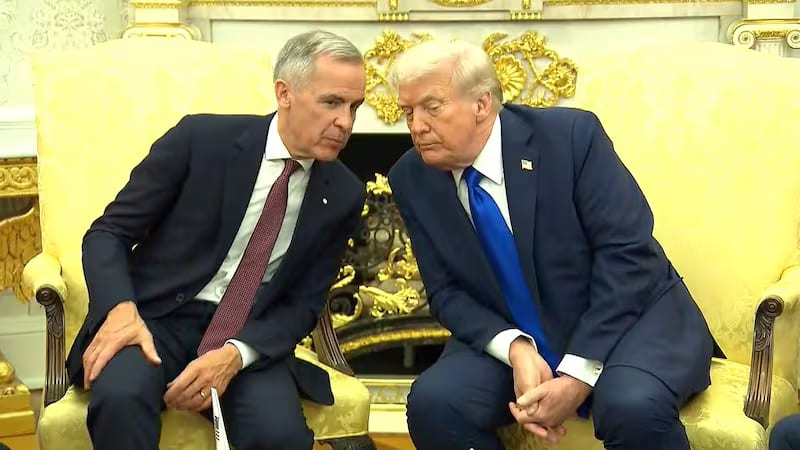
Choosing a tactical response of either variety, and maintaining it, may be best – waiting it out till Trump changes. Watching Trump and his upcoming discussions with Canada’s Prime Minister Mark Carney may prove to underscore Trump’s transactional fleeting impulses. We shall watch.
Image Credit – CTV News